The weekday tours are at 10 A.M., and since we had to drive a little over an hour to get there on time, we were a little early. It was a slightly nippy morning, and the sun was still low enough to keep this clearing in shadow. When I walked to the brink of the slope, I startled some deer that had been feeding there. I really love this view!

The Gregory House is an antebellum "big house" from a nearby plantation. It was not, however, built on this bluff; it was built across the Apalachicola River on much lower ground, convenient to river traffic. This made it vulnerable to damage from flooding, and in fact the house was in pretty sad shape when the CCC moved it to its current location. It had been abandoned since 1916, when the last surviving daughter of the original builder (if I remember the relationship correctly) finally died.

This is the front room. That wooden post on the dresser is one of the few items original to the house; it was to hold the planter's top hat, and it is made of Torreya wood. You won't be able to get one of these for yourself -- the Florida Torreya is listed as critically endangered.

This bed is another item original to the house. It belonged to the last resident owner, the daughter mentioned above.

This trunk belonged to one of the Gregory men who fought to repel Yankee aggression. You can see it in the corner of the bedroom above.

This is a "courting table". A young couple could court until the candle burned to the top of the candlestick. The parents could adjust the candle higher or lower, depending on whether they approved of the suitor or not.

When I was very young, all the talk about how old this house is made me afraid that it might collapse at any minute, and I refused to go up these stairs. Today their most notable feature is the low railing. Mr. Gregory was not a tall man.

Here's that view again, this time from the balcony. As you can see, the sun has risen noticeably by this time.

This view from the balcony looks down onto a trail to some Confederate gun pits. During the war, a chain was strung across the river to hold any enemy boat until the cannons could sink it.
The trail used to go down past the gun pits to the river, cross in front of the clearing, and come back up the other side of the lawn. The last time I went down that trail was during graduate school, and the part near the river was in danger of being destroyed by erosion as the river meanders. My understanding is that trail has been re-routed, and is now somewhat easier on the way back up.
By the way, our tour group was very small: just the ranger, one couple in their 50's, another in their 60's, and my dad and me. One of the tourists was a photographer who really, really wanted to be told that the Gregory House is haunted. The ranger's first answer was, I think, his most honest answer: "No, it isn't." Since the photographer kept badgering him, though, he started to adjust his story to what the tourist wanted to hear.
- "Well, I've never seen anything, but some people are more sensitive, and they pick up on things I don't."
- "While the house was abandoned, it was sometimes used by tramps. The story is that one time they got into a fight over cards, and one of them was murdered right here on the staircase."
- "Don't tell her I said this, but the other ranger refuses to come in here alone, even to change a battery in the smoke detector."
- "She's said that she will be working in the office and hear the sound of children playing, but when she looks out, no one is there. But we all think she's a little nuts."
Of course, I have no way of knowing if it is haunted or not. What I can say is that I've been in a number of buildings with much creepier feelings to them: for example, both the Keith Albee and the Frederick here in Huntington, and definitely the older wing of the old Science Building at Texas A&M-Commerce. (The old Science Building has been torn down; I do not mean the new building that was put up around 2005.)
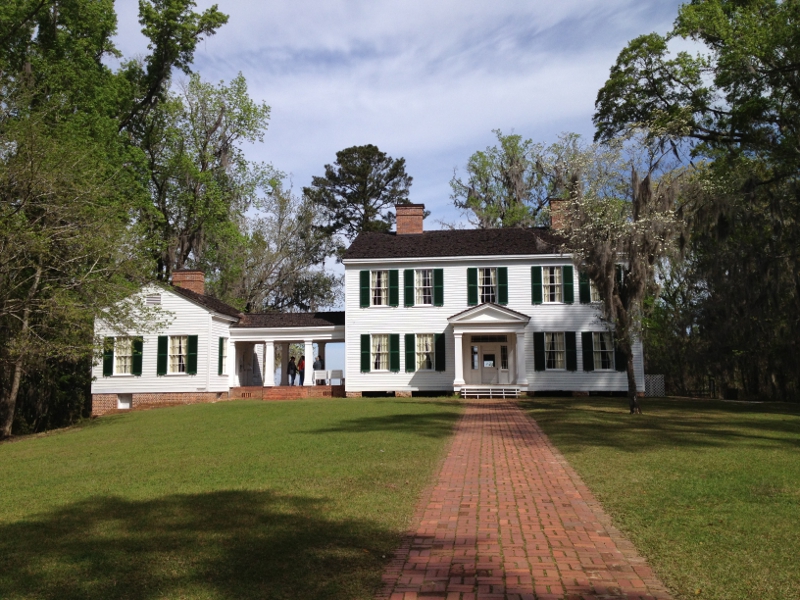
The Gregory House, on the other hand, is just a charming old house. Apparently the idea once was to restore it as a bed and breakfast. It would have made a fantastic bed and breakfast, and for several reasons -- interior doors, a few electrical sockets, and even an inside bathroom have been added; the bottom floor had to be completely replaced; few of the furnishings are original; and the site is not its historical location -- such a use would not be destroying a pristine relic of the antebellum South. People who wanted a relaxing stay in an historic building with a great view would get it, and those who wanted to believe they were sleeping in a haunted mansion could no doubt convince themselves that that was what they were doing, too.
The Gregory House, on the other hand, is just a charming old house. Apparently the idea once was to restore it as a bed and breakfast. It would have made a fantastic bed and breakfast, and for several reasons -- interior doors, a few electrical sockets, and even an inside bathroom have been added; the bottom floor had to be completely replaced; few of the furnishings are original; and the site is not its historical location -- such a use would not be destroying a pristine relic of the antebellum South. People who wanted a relaxing stay in an historic building with a great view would get it, and those who wanted to believe they were sleeping in a haunted mansion could no doubt convince themselves that that was what they were doing, too.