The US Conference of Catholic Bishops is sponsoring a "Fortnight for Freedom" from June 21-July4. This is to be "a 14-day period of prayer, education and action in support of religious freedom" -- and it really should include, I might add, fasting.

Please join in with a renewed prayer effort during this time, whether you are Catholic or not. Many of the prayers here and here can be used by any Christian; I suspect most Catholics will prefer traditional prayers like the Rosary, the Memorare, the Litany of the Holy Name of Jesus, etc.
One thing I intend to do is to learn the words to the hymn above: "O Lord, Save Thy People." Yes, I know it's specifically Orthodox, but the Holy Father is working hard to heal that rift, and it's a beautiful hymn that says it well.
Thanks to Simcha Fisher, by the way, for pointing this out. I share her distaste for the upcoming election and her conviction that politics alone is not a cause for hope.
Over the years I have become convinced that modern writers simply do not know how to tell a proper ghost story. The problem almost always lies in an inadequate philosophical background. Many writers today appear to be materialists, so they are left with only physical terror and psychological thrills, but no true horror.
This is probably most evident in the modern treatment of vampires. The two most important things to remember about vampires are
- vampires are dead, and
- vampires are demon-possessed.
Vampires are not just kinda pale and moody. They are not merely infected with a virus. There is no hope of them being or becoming a good guy. If you write a story like that, you are not really writing a story about vampires. In almost all modern "vampire" stories, the "vampire" is clearly not really dead; they're angst-filled teenagers or twenty-something jerks.
As another example, take pretty much anything written by H.P. Lovecraft, who seems to appeal chiefly to boys between 12 and 21. His ideas for horror seem to boil down to the following:
- Big is scary.
- Old is scary.
- Tentacles are scary.
- Big words from the thesaurus are scary.
That's pretty much it; if you agree with his ideas, he's a genius of the horror genre -- otherwise he's an enormous bore.
Fortunately, there are good stories out there, too. Some of the best come from M.R. James, who had precisely the knowledge of ancient and medieval religious beliefs, writings, and practices to give his stories a proper depth. So when the villain in "Lost Hearts" writes a reference in his diary about the purported magical practices of Simon Magus as recounted in the so-called Recognitions of Clement, it is a bit creepy to discover that there really is such a book and that it says exactly what is quoted in the story. Also, as is conceded in the story, this book, though of ancient origin, is not a genuine work of Pope St. Clement.
Another excellent writer of ghost stories had his own interesting story to account for the learning evident in his writings. Robert Hugh Benson was the son of an Archbishop of Canterbury; after his father's death, he converted to the Catholic Church and became a priest, then a monsignor. His book The Necromancers is an excellent warning against the Spiritualism of his day and the "ghost hunting" of our own.
Perhaps my favorite work of his pertaining to ghost stories is A Mirror of Shalott, which begins with an instructive philosophical argument between several priests, some of whom were entirely skeptical that ghostly appearances occurred as in popular tales, and others of whom were more accepting. They agreed, however, that each evening one of them would recount some odd event from his own experience. In fact, I suspect that these are indeed fictionalized versions of accounts Msgr. Benson heard firsthand; something like one of them happened separately to a friend and to me.
An important thing to remember is that a proper ghost story is always a morality tale. Usually, the ghost appears to exact punishment on someone for a serious offense, which may be murder, greed, inappropriate curiosity, dabbling in sorcery, or something similar.
Jill Tarter is right that the science fiction staple of aliens wanting to eat us is virtually guaranteed to be wrong -- to say nothing of Star Trek and its idea that most aliens are basically exaggerated Americans with funny ears or foreheads who can freely interbreed with each other. No, it is very likely that any truly alien life will have major chemical differences from familiar Earth life -- even if that alien life is also based on organic chemistry and water.
That doesn't mean we'd necessarily be safe, though. Aliens who made it to the solar system would see Mars as prime real estate -- nice and empty, all they have to do is move in their furniture and hang some pictures. (That is "terraforming" Mars to make it habitable for them should be no trouble for a species that could travel between stars, and the difficulty of interstellar travel would mean they would want some kind of payoff at the end.) The only downside would be the messy neighbors.
Earth would be too much of a mess for them to want to come here. They may not actually be susceptible to a War of the Worlds-type infection, but the fact that Earth's own life is in every little nook and cranny would make it difficult to establish their own biosphere here, nor would they feel a need to. Just to be on the safe side and keep us from tracking our muddy shoes across their new carpet, though, they might very well nuke us back to the stone age, after which they would make sure we never again achieved space flight.
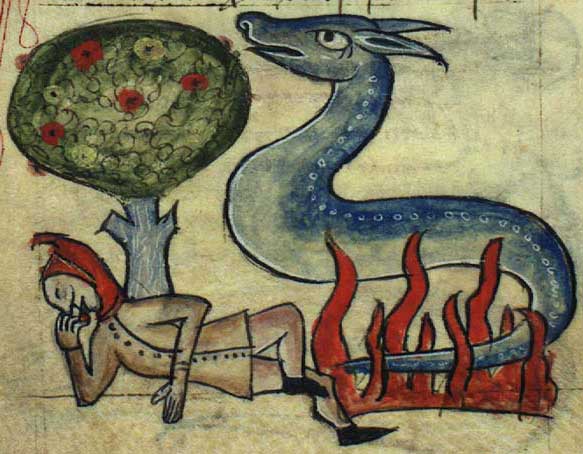
Several years ago I had a dream in which there were some unexplained features in the earthquakes associated with a volcano. We went to where we could look at the churning lava, and at first it looked just like regular convection rolls. Then, as we continued to watch, it became clear that these were not just convection rolls, they were in fact living beings made of the same materials as the lava itself; they were salamanders. In fact, in shape they were not unlike the amphibians.
 This discovery made me hugely excited: here was silicon-based life living inside the Earth. It would be more biochemically distinct from familiar life than anything we might find on the surface of Mars.
This story reminded me of that dream. We really know very little about what happens in the deepest depths of the Earth. We do know, though, that at the core-mantle boundary we have
- a fluid (liquid iron), that might act as a solvent,
- a solid surface,
- interesting chemistry, and
- a flow of energy.
If the chemistry is interesting enough -- and at this point, I think it's safe to say we can't be sure -- these conditions sound like the basic requirements for life.
Maybe those salamanders really are down there, after all.
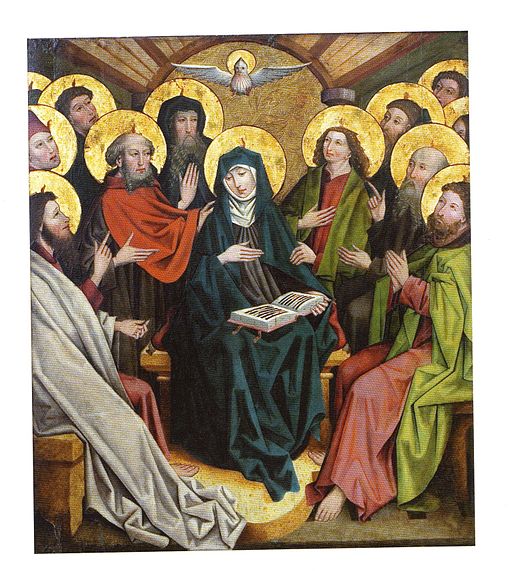
Today is Pentecost, one of the holiest days of the year. Somehow, thanks be to God, it has resisted being made into a commercial event, as has sadly happened to both Christmas and Easter. This is probably, I am sad to say, because many Protestants (by number, though probably not by count of denominations) largely ignore Pentecost. At least that was my experience with the independent Bible churches and the Southern Baptists; they would remember secular holidays (Mothers' Day, Memorial Day, Independence Day) and forget Pentecost.
Memorial Day is a day to honor and remember those who died serving their country in the military. That, however, is not what you will hear this weekend.
 Isn't it unfair to honor those who died and not those who served and survived, our veterans? What about those who served their country in some other way -- maybe the peace corps or civil service? Shouldn't we be more inclusive?
No, we should not. Veterans Day is for those who survived, Memorial Day is for those who did not. All other patriots and happy aspects of our country may be celebrated on Independence Day. If we try observer everything at once, it is too much, and we will observe nothing in particular; we will treat this as just a 3-day weekend.
Do those who gave their lives for this country deserve a day when they will be singled out for honor?
Yes. They do.
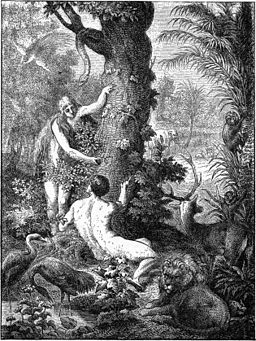
I was reared in a small, fundamentalist Bible church, and from kindergarten through eighth grade I attended a like-minded small Christian school. Most of the teachers were mothers of students. What they lacked in specialized training they made up for in care, and the standardized test scores showed that they significantly outperformed their colleagues in the public schools. However, there were a few peculiarities with this system, and one of them was a naive interpretation of the first few chapters of Genesis.
 I say
naive, not literal, because it turns out that there is an ancient tradition of looking very carefully at each word -- more carefully, I might add, than my fundamentalist elders did -- but without assuming, for example, that the "waters" referred to in Genesis 1:2 are necessarily H2O. St. Augustine argued that this was merely a picture for formless matter, because liquid water does not hold any shape and because the waves are caused by the wind (which is a picture for the Spirit), not the other way around. St. Augustine was neither the first nor the last to reason in this way, but rather than go into details, I will simply refer the interested reader to Saint Augustine on Genesis: Two Books on Genesis Against the Manichees and on the Literal Interpretation of Genesis : An Unfinished Book or, for those who do not wish to buy the book, to this excerpt.
I did not find out about this tradition for a long time, though, and I was left to struggle with the stark contradiction between what I had been taught in my fundamentalist upbringing and palaeontology. Could there be, as had been strongly hinted, some atheistic conspiracy in science to deny the evidence that the world was created only 6000 years ago? I finally concluded that no, this could not be; the science was fundamentally right. As were the Scriptures. If I am not clever enough to understand how they can both be right, that is my problem, not a problem with either science or Scripture.
How, though, could science and Scripture both be true while giving such divergent descriptions of human origins? This led me to consider the different truthful answers that can be given to a young child who asks the question, "Where did I come from?"
Here's one possible answer. "Well, the atoms in your body come from what you eat. What you eat comes from the grocery store. So you come from the grocery store." This is true, but it is not what the child is asking and will not satisfy the child.
Many parents apparently think this is time to give some version of "the birds and the bees" talk, explained in a way suitable for the child's age -- at least enough to explain that the child's hair color comes from her father, and her eye color comes from her mother. This answer is also true, but it is also not what the child is asking.
What the child is really struggling with is a serious philosophical question. "I know that although I am now a living, rational soul, there was a time before I existed. How does that happen?" The child's question is more grown-up, really, than the question that parents usually think the child is asking. The Catholic Church's answer to the child's question is that each soul is a special creation by God, and only God knows exactly how He does this.
Biological evolution answers the question of the origin of our species in the same way that sexual reproduction answers the question of our origin as individuals. Both are true; both are the "scientific" answer; both are answers that seem, at least at first, to be an affront to our dignity. Neither answers the more fundamental and important questions.
I say
naive, not literal, because it turns out that there is an ancient tradition of looking very carefully at each word -- more carefully, I might add, than my fundamentalist elders did -- but without assuming, for example, that the "waters" referred to in Genesis 1:2 are necessarily H2O. St. Augustine argued that this was merely a picture for formless matter, because liquid water does not hold any shape and because the waves are caused by the wind (which is a picture for the Spirit), not the other way around. St. Augustine was neither the first nor the last to reason in this way, but rather than go into details, I will simply refer the interested reader to Saint Augustine on Genesis: Two Books on Genesis Against the Manichees and on the Literal Interpretation of Genesis : An Unfinished Book or, for those who do not wish to buy the book, to this excerpt.
I did not find out about this tradition for a long time, though, and I was left to struggle with the stark contradiction between what I had been taught in my fundamentalist upbringing and palaeontology. Could there be, as had been strongly hinted, some atheistic conspiracy in science to deny the evidence that the world was created only 6000 years ago? I finally concluded that no, this could not be; the science was fundamentally right. As were the Scriptures. If I am not clever enough to understand how they can both be right, that is my problem, not a problem with either science or Scripture.
How, though, could science and Scripture both be true while giving such divergent descriptions of human origins? This led me to consider the different truthful answers that can be given to a young child who asks the question, "Where did I come from?"
Here's one possible answer. "Well, the atoms in your body come from what you eat. What you eat comes from the grocery store. So you come from the grocery store." This is true, but it is not what the child is asking and will not satisfy the child.
Many parents apparently think this is time to give some version of "the birds and the bees" talk, explained in a way suitable for the child's age -- at least enough to explain that the child's hair color comes from her father, and her eye color comes from her mother. This answer is also true, but it is also not what the child is asking.
What the child is really struggling with is a serious philosophical question. "I know that although I am now a living, rational soul, there was a time before I existed. How does that happen?" The child's question is more grown-up, really, than the question that parents usually think the child is asking. The Catholic Church's answer to the child's question is that each soul is a special creation by God, and only God knows exactly how He does this.
Biological evolution answers the question of the origin of our species in the same way that sexual reproduction answers the question of our origin as individuals. Both are true; both are the "scientific" answer; both are answers that seem, at least at first, to be an affront to our dignity. Neither answers the more fundamental and important questions.


